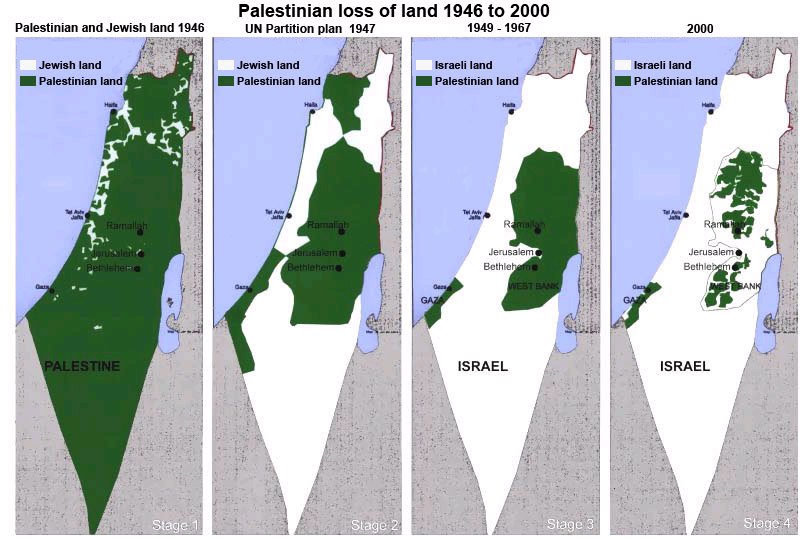
I only want to cover the history briefly, in any formal presentations, however, i decided to provide a fairly detailed outline of the history, as i believe it is very important in understanding the current situation.
1250 BC: Israelites began to conquer and settle the land of Canaan on the eastern Mediterranean coast.
961-922 BC: Reign of King Solomon and construction of the Temple in Jerusalem. Solomon’s reign was followed by the division of the land into two kingdoms.
586 BC: The southern kingdom, Judah, was conquered by the Babylonians, who drove its people, the Jews, into exile and destroyed Solomon’s Temple. After 70 years the Jews began to return and Jerusalem and the temple were gradually rebuilt.
333 BC: Alexander the Great’s conquest brought the area under Greek rule.
165 BC: A revolt in Judea established the last independent Jewish state of ancient times.
63 BC: The Jewish state, Judea, was incorporated into the Roman province of Palestine
70 AD: A revolt against Roman rule was put down by the Emperor Titus and the Second Temple was destroyed. This marks the beginning of the Jewish Diaspora, or dispersion.
118-138 AD: During the Roman Emperor Hadrian’s rule, Jews were initially allowed to return to Jerusalem, but – after another Jewish revolt in 133 – the city was completely destroyed and its people banished and sold into slavery.
638 AD: Conquest by Arab Muslims ended Byzantine rule (the successor to Roman rule in the East). The second caliph of Islam, Omar, built a mosque at the site of what is now the al-Aqsa Mosque in Jerusalem in the early years of the 8th Century. Apart from the age of the Crusaders (1099-1187), the region remained under Muslim rule until the fall of the Ottoman Empire in the 20th Century.
1897: The First Zionist Congress met in Basle, Switzerland, to discuss the ideas set out in Theodor Herzl’s 1896 book Der Judenstaat (The Jewish State). Herzl, a Jewish journalist and writer living in Vienna, wanted Jews to have their own state – primarily as a response to European anti-Semitism.
The Congress issued the Basle Programme to establish a “home for the Jewish people in Palestine secured by public law” and set up the World Zionist Organisation to work for that end.
A few Zionist immigrants had already started arriving in the area before 1897. By 1903 there were some 25,000 of them, mostly from Eastern Europe. They lived alongside about half a million Arab residents in what was then part of the Turkish Ottoman Empire. A second wave of about 40,000 immigrants arrived in the region between 1904 and 1914.
1917: At the time of World War I the area was ruled by the Turkish Ottoman empire. Turkish control ended when Arab forces backed by Britain drove out the Ottomans.
Britain occupied the region at the end of the war in 1918 and was assigned as the mandatory power by the League of Nations on 25 April 1920.
During this period of change, three key pledges were made.
In 1916 the British Commissioner in Egypt, Sir Henry McMahon, had promised the Arab leadership post-war independence for former Ottoman Arab provinces.
However, at the same time, the secret Sykes-Picot Agreement between war victors, Britain and France, divided the region under their joint control.
Then in 1917, the British Foreign Minister Arthur Balfour committed Britain to work towards “the establishment in Palestine of a national home for the Jewish people”, in a letter to leading Zionist Lord Rothschild. It became known as the Balfour Declaration.
1929 – 1936: The Zionist project of the 1920s and 1930s saw hundreds of thousands of Jews emigrating to British Mandate Palestine, provoking unrest in the Arab community.
In 1922, a British census showed the Jewish population had risen to about 11% of Palestine’s 750,000 inhabitants. More than 300,000 immigrants arrived in the next 15 years.
Zionist-Arab antagonism boiled over into violent clashes in August 1929 when 133 Jews were killed by Palestinians and 110 Palestinians died at the hands of the British police.
Arab discontent again exploded into widespread civil disobedience during a general strike in 1936. By this time, the militant Zionist group Irgun Zvai Leumi was orchestrating attacks on Palestinian and British targets with the aim of “liberating” Palestine and Transjordan (modern-day Jordan) by force.
In July 1937, Britain, in a Royal Commission headed by former Secretary of State for India, Lord Peel, recommended partitioning the land into a Jewish state (about a third of British Mandate Palestine, including Galilee and the coastal plain) and an Arab one.
Palestinian and Arab representatives rejected this and demanded an end to immigration and the safeguarding of a single unified state with protection of minority rights. Violent opposition continued until 1938 when it was crushed with reinforcements from the UK.
1947: Britain, which had ruled Palestine since 1920, handed over responsibility for solving the Zionist-Arab problem to the UN in 1947.
The territory was plagued with chronic unrest pitting native Arabs against Jewish immigrants (who now made up about a third the population, owning about 6% of the land). The situation had become more critical with the displacement of hundreds of thousands of Jews fleeing the Nazi persecution in Europe. Some six million Jews were killed in the Holocaust during World War II.
The UN set up a special committee which recommended splitting the territory into separate Jewish and Palestinian states. Palestinian representatives, known as the Arab Higher Committee, rejected the proposal; their counterparts in the Jewish Agency accepted it.
The partition plan gave 56.47% of Palestine to the Jewish state and 43.53% to the Arab state, with an international enclave around Jerusalem. On 29 November 1947, 33 countries of the UN General Assembly voted for partition, 13 voted against and 10 abstained. The plan, which was rejected by the Palestinians, was never implemented.
Britain announced its intention to terminate its Palestine mandate on 15 May 1948 but hostilities broke out before the date arrived.
The death of British soldiers in the conflict made the continuing presence in Palestine deeply unpopular in Britain. In addition, the British resented American pressure to allow in more Jewish refugees – a sign of growing US support for Zionism.
Both Arab and Jewish sides prepared for the coming confrontation by mobilising forces. The first “clearing” operations were conducted against Palestinian villages by Jewish forces in December.
1948: The State of Israel, the first Jewish state for nearly 2,000 years, was proclaimed at 1600 on 14 May 1948 in Tel Aviv. The declaration came into effect the following day as the last British troops withdrew. Palestinians remember 15 May as “al-Nakba”, or the Catastrophe.
The year had begun with Jewish and Arab armies each staging attacks on territory held by the other side. Jewish forces, backed by the Irgun and Lehi militant groups made more progress, seizing areas alloted to the Jewish state but also conquering substantial territories allocated for the Palestinian one.
Irgun and Lehi massacred scores of inhabitants of the village of Deir Yassin near Jerusalem on 9 April. Word of the massacre spread terror among Palestinians and hundreds of thousands fled to Lebanon, Egypt and the area now known as the West Bank.
The Jewish armies were victorious in the Negev, Galilee, West Jerusalem and much of the coastal plain.
The day after the state of Israel was declared five Arab armies from Jordan, Egypt, Lebanon, Syria and Iraq immediately invaded Israel but were repulsed, and the Israeli army crushed pockets of resistance. Armistices established Israel’s borders on the frontier of most of the earlier British Mandate Palestine.
Egypt kept the Gaza Strip while Jordan annexed the area around East Jerusalem and the land now known as the West Bank. These territories made up about 25% of the total area of British Mandate Palestine.
1967: Mounting tensions between Israel and its Arab neighbours culminated in six days of hostilities starting on 5 June 1967 and ending on 11 June – six days which changed the face of the Middle East conflict.
Israel seized Gaza and the Sinai from Egypt in the south and the Golan Heights from Syria in the north. It also pushed Jordanian forces out of the West Bank and East Jerusalem.
Egypt’s powerful air force was put out of action on the first day of fighting when Israeli jets bombed it on the ground in a pre-emptive strike.
The territorial gains doubled the area of land controlled by Israel. The victory heralded a new age of confidence and optimism for Israel and its supporters.
The UN Security Council issued resolution 242, stressing “the inadmissibility of the acquisition of territory by war and the need to work for a just and lasting peace in which every State in the area can live in security”. The resolution called for the “withdrawal of Israeli armed forces from territories occupied in the recent conflict”. It also called for an end to “all claims or states of belligerency and respect for… the sovereignty… of every state in the area and their right to live in peace… free from threats or acts of force”.
According to the UN, the conflict displaced another 500,000 Palestinians who fled to Egypt, Syria, Lebanon and Jordan.
1974: In the 1970s, under Yasser Arafat’s leadership, PLO factions and other militant Palestinian groups such as Abu Nidal launched a series of attacks on Israeli and other targets.
One such attack took place at the Munich Olympics in 1972 in which 11 Israeli athletes were killed.
But while the PLO pursued the armed struggle to “liberate all of Palestine”, in 1974, Arafat made a dramatic first appearance at the United Nations mooting a peaceful solution.
He condemned the Zionist project, but concluded: “Today I have come bearing an olive branch and a freedom fighter’s gun. Do not let the olive branch fall from my hand.”
The speech was a watershed in the Palestinians’ search for international recognition of their cause.
A year later, a US State Department official, Harold Saunders, acknowledged for the first time that “the legitimate interests of the Palestinian Arabs must be taken into account in the negotiating of an Arab-Israeli peace”.
1979: Egyptian President Anwar Sadat stunned the world by flying to the Jewish state and making a speech to the Israeli parliament in Jerusalem on 19 November 1977.
Sadat became the first Arab leader to recognise Israel, only four years after launching the October 1973 war (known as the Yom Kippur war in Israel). The war was indecisive after Egypt and Syria had attacked Israeli forces occupying Sinai and the Golan Heights. It ended with the issuing of UN Resolution 338 calling for “a just and durable peace in the Middle East”.
Egypt and Israel signed the Camp David accords in September 1978 outlining “the framework for peace in the Middle East” which included limited autonomy for Palestinians. A bilateral Egyptian-Israeli peace treaty was signed by Sadat and Israeli Prime Minister Menachem Begin six months later in March 1979.
The Sinai Peninsula, which Israel had seized in the 1967 war, was returned to Egypt.
Arab states boycotted Egypt for breaking ranks and negotiating a separate treaty with Israel.
Sadat was assassinated in 1981 by Islamist elements in the Egyptian army, who opposed peace with Israel, during national celebrations to mark the anniversary of the October war.
1987: A mass uprising – or intifada – against the Israeli occupation began in Gaza and quickly spread to the West Bank.
Protest took the form of civil disobedience, general strikes, boycotts on Israeli products, graffiti, and barricades, but it was the stone-throwing demonstrations against the heavily-armed occupation troops that captured international attention.
The Israeli Defence Forces responded and there was heavy loss of life among Palestinian civilians. More than 1,000 died in clashes which lasted until 1993.
1993: The election of the left-wing Labour government in June 1992, led by Yitzhak Rabin, triggered a period of frenetic Israeli-Arab peacemaking in the mid-1990s.
The government – including the “iron-fisted” Rabin and doves Shimon Peres and Yossi Beilin – was uniquely placed to talk seriously about peace with the Palestinians. The PLO, meanwhile, wanted to make peace talks work because of the weakness of its position due to the Gulf War.
Israel immediately lifted a ban on PLO participants in the stalemated bilateral meetings in Washington. More significantly Foreign Minister Peres and his deputy Beilin explored the possibility of activating a secret forum for talks facilitated by Norway.
With the Washington bilateral talks going nowhere, the secret “Oslo track” – opened on 20 January 1993 in the Norwegian town of Sarpsborg – made unprecedented progress. The Palestinians consented to recognise Israel in return for the beginning of phased dismantling of Israel’s occupation.
Negotiations culminated in the Declaration of Principles, signed on the White House lawn and sealed with a historic first handshake between Rabin and Yasser Arafat watched by 400 million people around the world.
1996 – 1999: Conflict returned early in 1996 with a series of devastating suicide bombings in Israel carried out by the Islamic militant group Hamas, and a bloody three-week bombardment of Lebanon by Israel.
Peres narrowly lost elections on 29 May to the right-wing Binyamin “Bibi” Netanyahu, who campaigned against the Oslo peace deals under the motto “Peace with Security”.
Netanyahu soon enflamed Arab opinion by lifting a freeze on building new settlements in the occupied territories and provoking fears about undermining Muslim holy sites in Jerusalem by opening an archaeological tunnel under the compound of al-Aqsa mosque – one of Islam’s holiest sites.
Despite his antagonism towards the existing peace process, Netanyahu, under increasing US pressure, handed over 80% of Hebron in January 1997 and signed the Wye River Memorandum on 23 October 1998 outlining further withdrawals from the West Bank.
But his right-wing coalition collapsed in January 1999 in disarray over the implementation of the Wye deal. He lost elections on 18 May to Labour’s Ehud Barak who pledged to “end the 100-year conflict” between Israel and the Arabs within one year.
The five-year interim period defined by Oslo for a final resolution passed on 4 May 1999, but Yasser Arafat was persuaded to defer unilateral declaration of Palestinian statehood to give a chance for negotiations with the new administration.
2001: By the end of 2000 Israeli Prime Minister Ehud Barak found himself presiding over an increasingly bitter and bloody cycle of violence as the intifada raged against Israel’s occupation in the West Bank and Gaza.
With his coalition collapsing around him, Barak resigned as prime minister on 10 December to “seek a new mandate” to deal with the crisis. However in elections on 6 Febuary, Ariel Sharon was swept to power by an Israeli electorate that had overwhelmingly turned its back on the land-for-peace formulas of the 1990s and now favoured a tougher approach to Israel’s “Palestinian problem”.
The death toll soared as Sharon intensified existing policies such as assassinating Palestinian militants, air strikes and incursions into Palestinian self-rule areas. Palestinian militants, meanwhile, stepped up suicide bomb attacks in Israeli cities.
The US spearheaded international efforts to calm the violence. Envoy George Mitchell led an inquiry into the uprising, while CIA director George Tenet negotiated a ceasefire – but neither initiative broke the cycle of bloodshed.
2002: Palestinian militants carried out an intense campaign of attacks in the first three months of the year, including a hotel bombing which killed 29 on the eve of the Jewish Passover holiday.
In response, Israel besieged Yasser Arafat in his Ramallah compound for five weeks and sent tanks and thousands of troops to re-occupy almost all of the West Bank.
Months of curfews and closures followed as Israel carried out operations it said were aimed at destroying the Palestinian terrorist infrastructure.
Controversy raged as Israeli forces entered and captured the West Bank city of Jenin in April. A UN report later refuted Palestinian claims of a massacre, but Amnesty International concluded that the Israeli army had committed war crimes in Jenin and also Nablus.
May saw a five-week stand-off between the Israeli army and a large group of militants and civilians sheltering inside Bethlehem’s Church of the Nativity.
In June, US President George Bush called for Palestinians to replace their leader with one not “compromised by terror”, and outlined a timetable for negotiations which would later become the plan known as the “roadmap”.
Israel began building a barrier in the West Bank, which it said was to prevent attacks inside Israel, although Palestinians feared an attempt to annex land.
Mr Arafat faced heavy pressure to reform the Palestinian Authority and rein in the militants.
Palestinian attacks continued, met with periodic Israeli incursions and a ten-day siege which reduced much of Mr Arafat’s compound to rubble.
2003: After several Palestinian attacks in January, Israel stepped up operations against Hamas, killing the militant group’s founder.
With the US and Israel continuing to refuse to deal directly with Yasser Arafat, the Palestinian leader appointed Mahmoud Abbas as his prime minister.
In late April, the US published the much-delayed roadmap, which outlined a step-by-step timetable towards a negotiated Palestinian state, with the first phase contingent on an end to Palestinian violence and Israeli incursions and settlement activity.
In May, the Israeli cabinet endorsed the plan, though it put on record several reservations.
At a summit with the US president in Aqaba, Jordan, in June, Mr Abbas called for an end to the armed intifada, while Israeli President Ariel Sharon declared his support for the creation of a “democratic Palestinian state at peace with Israel”.
Further negotiations led to pull-backs of Israeli forces in Gaza and Bethlehem. Mr Abbas secured a temporary cessation of violence from Palestinian militant groups.
In August, after seven weeks of relative calm, the truce disintegrated with a spate of tit-for-tat Palestinian suicide bombings, Israeli raids and targeted killings.
After a long-running power struggle with Mr Arafat over control of the Palestinian security apparatus, Mr Abbas resigned in early September. He was replaced by Arafat loyalist Ahmed Qurei.
Construction of the West Bank barrier continued throughout the year despite growing international criticism.
The Israeli cabinet voted to “remove” Mr Arafat and in December Mr Sharon told the Palestinians he would implement a policy of unilateral separation unless they halted violence.
2004: Palestinian suicide bombings and Israeli air strikes continued. Israel provoked outrage among Palestinians by killing Hamas spiritual leader Sheikh Ahmed Yassin in a targeted missile attack in March.
A second senior leader, Abdel-Aziz al-Rantissi, was killed a month later.
In April Ariel Sharon revealed a “disengagement plan” which included the withdrawal of all 8,000 settlers and the troops that protect them in the Gaza Strip, and from three small settlements in the northern West Bank.
Construction of the West Bank barrier continued, despite increasing protests and changes to the route in response to a verdict in the Israeli High Court.
In July, the International Court of Justice in The Hague pronounced the barrier illegal, but Israel dismissed the non-binding ruling.
Intra-Palestinian political turmoil broke out over the summer as Yasser Arafat, Prime Minister Ahmed Qurei and various Palestinian factions battled over reform of the security forces.
After three bombings in August and September and numerous Palestinian rocket attacks on Israeli towns, Israel launched a major and bloody incursion into northern Gaza.
In late October Arafat was taken ill and flown to France for emergency treatment. He died of a mysterious blood disorder on 11 November.
The news was met with an outpouring of grief among Palestinians. Emotional crowds engulfed Mr Arafat’s compound in Ramallah as his body arrived by helicopter to be buried.
Mahmoud Abbas, who had spent a brief spell as prime minister in 2002, was confirmed as Arafat’s successor as chairman of the PLO.
2005: Mahmoud Abbas was elected president of the Palestinian Authority after a landslide victory in January elections.
But post-election attacks by Palestinian militants immediately threatened to derail hopes for renewed peace talks.
However, Mr Abbas deployed Palestinian police in northern Gaza and by February had persuaded Hamas and Islamic Jihad to begin a temporary, unofficial cessation of violence.
Mr Abbas and Mr Sharon went on to announce a mutual ceasefire at a summit in Egypt, although the militant groups stopped short of making their fragile – and far from watertight – truce official.
Preparations for – and controversy over – Ariel Sharon’s planned pullout from the Gaza Strip continued, with the Israeli Prime Minister securing cabinet backing and fending off calls for a referendum from opponents.
Despite widespread protests by settlers, the withdrawal went ahead in late August and early September, with emotional scenes as Israeli troops removed some settlers by force.